Jared Correia of the Massachusetts Law Office Management Assistance Program brings us Carded!: 10 Ways to Make Your Business Card Your Calling Card  Jared has some interesting and cutting-edge ideas that will certainly make you think. And why don't lawyers typically have their pictures on their business cards anyway? Tradition?

Well, way back in 2001, I wrote an piece called The Lawyer’s Business Card. I was reminded of it because Jared mentioned the back of the business card and for that article, a Tulsa lawyer shared with me an interesting idea about the back of his business cards.
Top 10 Ways To Get Fired By Your Lawyer is from Des Moines, Iowa attorney Brett J. Trout on his BlawgIT site. OK, it is only March, but in my opinion, this is one of the best blog posts of the year 2009. You will enjoy reading this.

But, of course, the audience you really want to read this is all of your present and future clients. I think Brett's post is going to get a lot of "link love" from a lot of people. But, Brett, after the traffic has subsided, you really need to think about converting this to a downloadable PDF (with your contact info in the footer, of course) and letting other lawyers hand it out to their new clients. Maybe this would be a great public service and marketing tool for you, or maybe they'd need to donate a small amount to your favorite charity for lifetime distribution rights.

But I digress. Go read Top 10 Ways To Get Fired By Your Lawyer and then send the link to someone who needs to read it too.

I've signed up with Twitter. If you are using Twitter, you can follow me @jimcalloway. You can look at my Twitter page at http://twitter.com/jimcalloway. You do not have to register with Twitter to view the pages of those using Twitter. (Well, almost all of them. A few lock them down with permissions.)

You may not have heard of Twitter yet. It is referred to as a microblogging service. Our posts to Twitter (known as Tweets) are limited to 140 characters.You can "follow" people and receive their Tweets as soon as they are posted on your Twitter page (or in other ways.) But Twitter has expanded from the simple idea of friends keeping track of each other's activities to become a significant new communication tool. Some celebrities have tens of thousands of people following their activites via Twitter. And of course, there are many who react to hearing of Twitter with "Where would I find time to do that?" (or in Twitter-ese, maybe "OMG! No time 2do")

I did tell a few people that I wouldn't sign up for Twitter until I had my e-mail inbox under control and, no, I haven't. But doing a presentation for TECHSHOW on the Road in Boston and seeing the number of people tweeting during the program about what was being said did raise my interest. So feel free to follow me and please don't take it personally if I don't follow you back. (Still that nagging inbox issue.) I'll try to tweet some useful information.The amount of tweeting at ABA TECHSHOW next month should be significant.

Here's a blog post on large law firms now utilizing Twitter.

OK, I know I mentioned celebrities. Serious lawyers should skip the next three links.

Forbes article "Why Celebrities Twitter"

New York Post article on best celebrities to follow.

25+ Celebrity Twitter Users (I already see new caeers opening for Ghost-Tweeters.)

But there's more than time-wasting and frivolity on Twitter.

For example, here are some of the legal ethicists on Twitter. 

http://twitter.com/billfreivogel

http://twitter.com/willhornsby

http://twitter.com/Ethics_Maven

http://twitter.com/michaeldowney

Here's the Wikipedia entry on Twitter. There's more, but I know some of you are dying to go check those celebrity links. I'll revisit this topic here later. (Psst…they say Lance Armstrong tweets over ten times a day. I haven't checked.) A bunch of journalists and politicos are tweeting, too.

3 Geeks and a Law Blog is a site I've been meaning to feature here for quite some time. Here's how the three"geeks" describe their blog: "A law blog addressing the foci of 3 intrepid law geeks, specializing in their respective fields of knowledge management, Internet marketing and library sciences, melding together to form the Dynamic Trio."  The authors are all employed by large Houston, TX law firms. (Two of them note 1000+ lawyers in their firm.) From reading the blog, you get an idea of their impressive knowledge and experience.

I've known Toby Brown and Greg Lambert for many years. Toby used to work for the Utah Bar Association and Greg used to work on the Oklahoma Supreme Court's website OSCN.Net. The third "geek" is Lisa Salazar, who seems very competent, even if she does allow her name to be associated online with these other two characters.

I certainly know Toby well enough to bust him for his title of Statistical Juxtaposition for a recent post on alternative fee arrangements.(No, Toby, the point of the title is to make people want to read the post.) Greg caught my interest with a post My "Mobile" Land Line – The Cheap Geek Buys a Magic Jack. (Oh, don't turn up your nose, dear reader. You've been wondering, too.) Last year, Toby and Greg uploaded the slide show for their presentation Is "Privacy" Still in the Dictionary? (Yes, guys, the definition starts with "A quaint Twentieth Century concept…") Lisa discusses online censorship in Censoring Social Networking: Can You Program Justice?

I hope these examples make you want to visit 3 Geeks and a Law Blog, this week's Website of the Week.

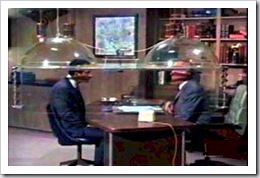
NLJ.com reported that news of impending layoffs at Pillsbury Winthrop Shaw Pittman broke due to corporate and securities head Robert Robbins having an indiscreet cell phone conversation that was overheard on a train. My question is why wasn't he using his Cone of Silence? I mean if Secret Agent Maxwell Smart can afford one, surely Pillsbury Winthrop could. Cone1

We have discussed on several occasions in our office how people often behave as if their cell phone conversations are protected by some mythical Cone of Silence. I was once entertained at lunch by a young lady at an adjoining table discussing details of the previous night's date that I bet her mother wouldn't want her sharing with strangers. My assistant, Sharon, and her mother were once disturbed by a lawyer returning calls while eating, including discussing in a very loud voice the details of a pending family law case with the opposing counsel.

Confidentiality and discretion should be second nature to a lawyer. Jay Foonberg tells the story of wife being angry with him when they visited some social acquaintances and she was unaware that they had adopted a baby. Jay's firm had handled the adoption. Mobile phones have ubiquitous in our society. So this situation is understandable, if not forgivable. I do sympathize. I have a loud voice myself. But before you talk to a client or about a client (or a proposed layoff) on your mobile phone, look around and be aware of your surroundings. Then talk very quietly. If you have to tell a client "I can't discuss that right now. I'm on a mobile phone in a public place," that's fine, too. The client should appreciate your discretion–as long you call them back promptly.

Well, they didn't actually use the word GMail. But in NYSBA Ethics Opinion 820 the committee said: "A lawyer may use an e-mail service provider that conducts computer scans of e-mails to generate computer advertising, where the e-mails are not reviewed by or provided to other individuals." I cannot believe I missed this one when it came out a year ago. More analysis is contained in Nerino Petro's Compujurist blog.

I love my Gmail account. As I've mentioned before, a Gmail account is great for managing your various e-mail subscription groups like Solosez or Lawtech. My friend Dan Coolidge has used a personal Yahoo account for years. Web-based e-mail accounts have their place and I am glad the NYSBA recognizes that a computer scan to produce context-related ads is not the same as someone reading your e-mail.

Law firm layoffs, bailouts and bank closings are in the news. It is sometimes hard not to dwell on so many negative events. So I've been doing a lot of thinking about law practice in this economy, as have a lot of others. I've just finished a two part series in the Oklahoma Bar Journal on this topic. Practicing Law in Tough Economic Times is an overview of some of the most interesting things I have read on the topic. More Thoughts on Practicing Law in Tough Economic Times is a collection of (mostly) my ideas that are applicable to most all law firms, but with an emphasis of small to medium-size law firms.

Thomas C. Grella, Asheville, NC lawyer and former chair of the ABA Law Practice Management Section, recently drew my attention to We are Optimists – We See the Cup at Least Half Full from the consulting firm Smock Sterling. This is a thoughtful approach to our new reality, a bit more focused on larger law firms. I particularly appreciated the Do's and Don'ts near the end.

Ross Kodner wrote SmallLaw: The Rise of BigSolo: Large Firm Refugees Who Start Their Own Law Firms for the Technolawyer Blog. This essay which contains more interesting tibits of information. Can you imagine the difference in monthly overhead for some of those lawyers?

Some of you must have read the subject line and wondered why I would pick The Invent Blog® as my Website of the Week. While it is true that I typically do not feature substantive law blogs, this is a great blog with value to most everyone. I met Stephen M. Nipper at an ABA TECHSHOW some years ago. Since then he has made The Invent Blog® into a well-respected and popular Intellectual Property law blog. But he also focuses on technology tips and how-to's that are useful for anyone. He obviously reads a lot online and delivers the most interesting things he finds to his reader. See his recent collection of Microsoft Outlook Tipshis thoughts on reserving your kid's domain names now so they can thank you for that later and how to check your Web page's SEO grade. Keep up the good work, Steve.

The Digital Edge Podcast recently featured an interview with Laura Calloway, Chair of ABA TECHSHOW 2009. If Laura had any concerns about being interviewed by two former ABA TECHSHOW Chairs, she certainly didn't show it. As always there are new things planned for this year's show. Listen to the podcast for more details.

As I've noted before, I am hardly unbiased about ABA TECHSHOW. It is simply the best. Because of its focus as a legal technology CLE program, there are many experts, writers and product reviewers there to speak. See how many names you recognize from the TECHSHOW faculty list. So you never know what interesting person you may be sitting by in a session or at lunch. It also features Solo and Small Firm tracks and many other sessions of use to lawyers in the small to medium firm setting. Here is the schedule of presentations. I know there are several programs of interest to you.

For the budget-minded, the Early Bird Deadline is February 28, 2009. So enroll by that time to save. Oklahoma Bar Association members can save even more by using the Code EP920 when they register. But it is time to register now and save some money before registration fees increase. Register online here.

Recently on Solosez there was a discussion of various ways to manage one's tasks. Case management software packages were discussed. Outlook 2007 has some powerful features for calendaring and tasks. The need of lawyers to keep track of tasks and appointments so they don't "drop the ball" has been with us since the beginning of lawyering. A surprising number of Solosezzers mentioned an online service called Remember the Milk. It is a "to-do" list and task manager. It really looks quite powerful.

Legal Andrew did a blog post on Law Firm Productivity with Remember the Milk. His explanation of how he has set up Remember the Milk for his needs is well worth reading. I think some of you who do not use practice management software might like his approach. I could also see a lawyer who does use practice managment software using Legal Andrew's setup for all of the personal, family and other non-business lists in her life. The RTM program is free, but power users will likely pay $25 per year for the Pro version to have it sync with iPhones, Blackberries or Windows Mobile devices.

Some lawyers break out in hives at the mere thought of posting possibly confidential client information on a site provided by a third party Software as a Service (SaaS) provider. Much of a to-do list for a lawyer would not fall into the confidential category. After all, the adverse party in litigation knows when the depositions are scheduled. MTM notes in its privacy policy that they maintain all of your posted information in order for the system to work and "Remember The Milk employees do not access the content of any task lists unless you specifically request them to do so (for example, if you are having technical difficulties accessing your account) or if required by law, to maintain our system, or to protect Remember The Milk or the public." This is a typical policy, but not reassuring to all lawyers.

The due diligence required before a lawyer is comfortable that they are protecting client confidences with any sort of online data service will vary from lawyer to lawyer and, perhaps, state to state. This is an on-going issue. In the same way we have seen faxing technology, computers, online legal research and e-mail muscle their way into the typical law office environment, access to calendar and to-do lists via a mobile phone is already deemed a minimum requirement by an increasing number of lawyers. Online lawyer matter management systems like RocketMatter and Clio are gaining in popularity. A password-protected online data system may have legal protection, but their security needs to be tough if lawyers are the customers.

Bottom line is that Remember the Milk looks like a good way for some lawyers to improve their practices to better serve clients and improve their lives by better managing themselves. The online case management systems have proponents as well. No one would blame a lawyer if their office was burglarized and client data compromised, unless, of course, they never locked the doors when they went home each day. With online systems, we just need to understand the "locks."